“750 Days of War”: Jevhen Magda at the Ukrainian Institute in Prague inaugural event
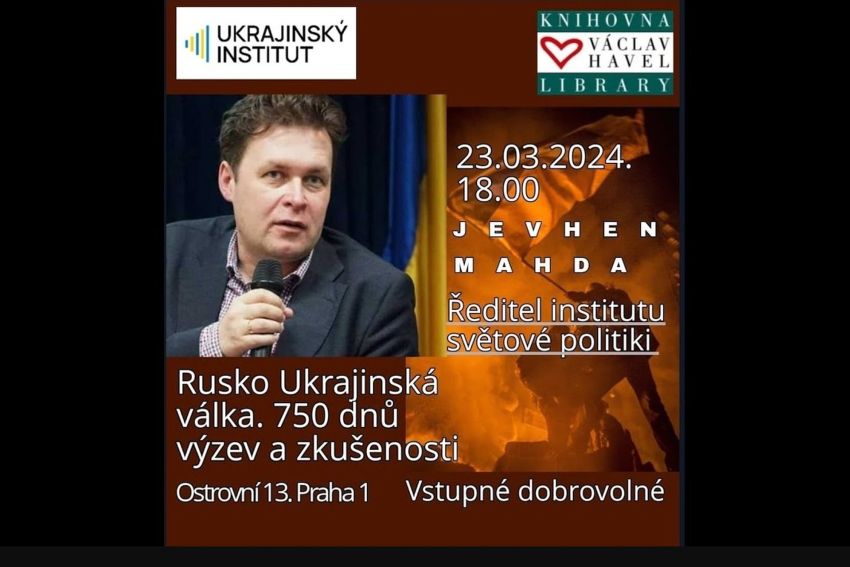
Jevhen Magda, Director of the Institute of World Policy, delivered a lecture titled “750 Days of War” at the Václav Havel Library — the first public event of the newly established Ukrainian Institute in Prague. The analyst examined the causes and course of the Russian-Ukrainian war, nuclear blackmail, information warfare, and the limits of international support for Ukraine.
Russia’s aggression proved far more extensive than most Western analysts had anticipated — and far less successful than the Kremlin had planned. It was this paradox that Jevhen Magda placed at the centre of his lecture, which marked the public debut of the Ukrainian Institute in Prague.
From a blitzkrieg to the largest conflict since World War II
Russia planned to seize Kyiv in days, replace the government, and push further. Instead, Ukraine halted the advance and transformed what Moscow called a “special military operation” into the largest armed conflict in the world since 1945. In terms of equipment deployed, munitions consumed, and the scale of fighting on land, at sea, and in the air, this war has no modern precedent.
Magda stressed that the aggression began in 2014 in hybrid form — yet millions of Ukrainians only grasped this on 24 February 2022, through missile strikes and human loss.
Nuclear blackmail and the collapse of non-proliferation
Ukraine’s decision to give up its nuclear arsenal in the early 1990s now carries a different meaning: a nuclear state attacked a country that had voluntarily disarmed. This effectively undermined the global non-proliferation regime. The deployment of tactical nuclear weapons in Belarus, the seizure of the Zaporizhzhia nuclear plant, and the systematic escalation of nuclear threats are all part of a deliberate strategy of intimidation — directed primarily at EU countries, not Ukraine itself.
“Russia exploited the leverage of a nuclear state with maximum effectiveness — without ever using a nuclear weapon.”
Information warfare as a new category of weapon
Magda described Russia’s information units as a fundamentally new branch of its military. Massive disinformation and propaganda — now aimed at the Global South as well — allow Moscow to wage a “war for reality,” constructing a fictional narrative where actual facts tell a different story. The West remains insufficiently protected against this instrument.
International support: what is missing
Despite the EU’s decision to allocate 50 billion euros over four years under the Ukraine Facility programme, Magda observed that this sum is unlikely to resolve even one systemic challenge of reconstruction. The United States, as the world’s leading military power, approaches arms deliveries cautiously, in line with its own strategic calculations. Bipartisan support for Ukraine in Washington is weakening — partly as a result of insufficient engagement with the Republican camp.
“If we stop speaking out, we risk losing. And losing is not an option.”
The lecture closed with an open discussion — on the role of the diaspora, communicating with local populations, and the need to change the language used to describe Russia: not a “federation,” but “an empire disguised as one.”